Tuesday, June 16, 2009

Things that make you go Hmmmm......

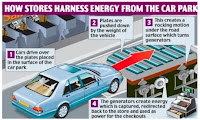
A UK retailer installed moving metal plates in their parking lot that generates energy when cars drive over them, which is then converted to electricity to run their cash registers.
This is a part of their sustainability effort which includes collecting rainwater to flu
sh toilets, solar thermal for hot water and sending food waste to a biomass plant instead of the landfill.
The idea is novel, but I question the benefit of the amount of
 resources needed to install and maintain this power-generating parking lot versus the amount of resources an electric company uses to produce the same 30 kWh per hour.
Hmmmm......

Friday, June 12, 2009

Electric Jet Car - I want one

The 500th electric Tesla Roadster was recently delivered and a 60-mile road rally with about 30 Roadsters in California commemorated the event, the largest gathering of Tesla Roadsters on public streets.

San Carlos, Calif.-based Tesla is the only production automaker selling highway-capable EVs in the United States or Europe. The Roadster beats nearly every other car in acceleration yet is twice as energy efficient as a Toyota Prius. It costs roughly $4 to refuel and can be completely recharged in as little as 3.5 hours.

"People who buy Roadsters are getting a superlative sports car that drives more like a performance jet than a car – and they are supporting a new American automaker committed to building well designed, high performance vehicles with a level of efficiency far greater than any other automaker in the world," said Jeremy Snyder, Tesla's General Manager for the South Western Territory.

The 500th Roadster went to Martin Tuchman, former chairman and CEO of Interpool, and chairman of The Tuchman Foundation and a board member of The Parkinson's Alliance and Parkinson's Disease Foundation of Columbia Presbyterian Hospital in New York. Tuchman said he plans to charge his Roadster partly with solar energy thanks to photovoltaic panels he helped install throughout his hometown of Kingston, NJ.

Monday, June 8, 2009

Search for Air France 447 Hindered by Garbage

Earlier in the week, rescue workers reported that they had found debris--two buoys and a cargo pallet--that had come from the downed Air France Flight 447 plane, but it turned out to just be floating garbage. Officials have had to turn to costly submarines to aid in locating signs of the plane amid the floating piles of waste.

Ocean-bound refuse tends to congregate in gyres. There are about five major “trash islands” in the world. Air France Flight 447 did not even go down in one of these major gyres; It fell into an area of minor trash congestion. The major gyres are mind-boggling and are 90% plastic waste. One of them, between North America and Asia, is twice the size of Texas.

It has a devastating impact on ocean life. Notably, sea turtles mistake the plastic bags for jellyfish and try to eat them. Birds also attempt to eat the floating chunklets of plastic
. The floating-garbage problem doesn't stop at marine life. The plastic acts as a sponge for harmful chemicals. The chemicals work their way through the food chain and end up in our food.

This art piece was inspired to bring awareness to the debris gyres in our ocean. The Environmental Cleanup Coalition is focused on removing this debris accumulation from the ocean. www.gyrecleanup.org.

Friday, June 5, 2009

Hilarious!

Monday, June 1, 2009

The "call letters" for going green is RRR - reduce, reuse, recycle.  An extreme example of reuse is the Cosmic Muffin, once a Howard Hughes TWA-owned Boeing 307 Stratoliner.  Destined for the scrap heap, the 307 was rescued in 1969 and converted into a "sleek and uniquely sensational motor yacht."
Yes, a boat.  Planeboats.com


Thursday, May 28, 2009

Home Depot Shareholders Want Green

Home Depot shareholders are asking Home Depot to assess its companywide energy use in its buildings, transportation, and supply chain; set energy use reduction targets; and report findings and progress to shareholders.

“Throughout the country—and the world—there is growing recognition of the need to use energy more efficiently. . . It’s time for Home Depot to step up to the plate,” said Connecticut State Treasurer Denise Nappier.

Corporate energy use and carbon footprint tracking is becoming increasingly important as the cost savings of going green are being recognized worldwide.

In a similar vein, earlier this month the stockholders of Chevron demanded that the company begin tracking its carbon footprint. 

Although carbon footprint tracking seems a daunting task for companies with several locations and divisions, a company called Clear Standards offers software that eases the pain.  The industry leading software also has modeling capabilities so you can "test" different energy-efficient solutions to find the most cost-effective ones before investing in any major changes.  Most importantly, it can also project how much green you will save by going green!

Tuesday, May 26, 2009

Arizona - The Solar Capital of the World?

Las Vegas is the Entertainment Capital of the World and sadly, Nevada is one of the foreclosure capitals of the world.  While Nevadans party their pain away, Arizona is looking on the bright side and becoming the solar capital of the world.

The sunny deserts of the Southwest United States is one of the ideal planetary locations for solar.  In fact, with the amount of sun and the available land, it could produce enough electricity to meet the electrical needs of the entire US!  Photovoltaics, or PVs, are 85 times as as efficient as growing corn for ethanol; on a 300 ft x 300 ft (1 hectare) plot of land, enough ethanol can be produced to drive a car 30,000 miles per year vs 2,500,000 miles by covering the same land with photo cells. Which is good news for the Southwest, where soil temperatures are often way above proper corn germination temps of 60 degrees!

A fact not lost on Arizona Public Service, they have announced another large solar plant - a 290 million watt concentrating solar plant, among the largest in the world, to be built in the Harquahala Valley, 75 miles west of Phoenix.  This is in addition to a 280-megawatt concentrating solar power plant to be built 70 miles southwest of Phoenix, near Gila Bend, Arizona.  Together the two plants will supply electricity to 143,000 consumers.

Not stopping there, Arizona Public Service, APS, offered Flagstaff customers the opportunity to help APS build an interconnected solar power plant – one rooftop at a time. For this program, APS will own and receive energy from solar panels installed on about 300 customer rooftops. Participating customers will not have any up-front costs or other requirements and they will receive a low 20-year fixed community power rate for the solar portion of their electricity bill.

APS staffers also celebrated with visitors as the Grand Canyon's Visitor Center went solar with 84 solar panels on the center's roof and on adjacent ground-mounted platforms. The 18 kilowatts of energy generated by the panels provide enough power to offset 30 percent of the center's electricity use. APS said that the Grand Canyon is important to their efforts "because of the opportunity that exists to educate more than 4.5 million Canyon visitors each year about renewable energy."

Maybe someday Nevadans will get over their hangovers and see the light.
Saturday, May 23, 2009

Plastiki, the bottled water boat!

Adventure Ecology founder David De Rothschild and his team plan to sail the Plastiki, a boat built entirely of plastic bottles and recycled waste products, from San Francisco to Sydney, Austraiia in August 2009 to raise awareness about the Eastern Pacific Garbage Patch, a floating landfill twice the size of Texas located between California and Hawaii, and the growing masses of plastic accumulating in our oceans. 

Building boats out of all that waste plastic isn't the solution, but de Rothschild is attempting to spark conversations about rethinking waste. De Rothschild explained that we consume 200 billion liters of bottled water per year, and only one in five bottles is actually recycled. He aims to showcase a solution, and encourage people to rethink waste as a resource.

“This is the hundredth year of plastic,” de Rothschild pointed out.  “Plastic is an amazing material and it is still misunderstood. I’m trying to get people to think about plastic as part of the solution.” 

When finished, the Plastiki will be made of 12,500 2-liter plastic bottles collected by Waste Management, will weigh 9 tons, and will have a crew of six. The Plastiki will have a composting toilet, onboard renewable energy and a garden.  When the voyage is done, the team plans to upcycle the boat.   

In parallel with the sailing of Plastiki, de Rothschild has launched a Smart Art Trash into Treasure competition (www.smartartcompetition.com) to inspire innovative solutions to waste. What’s your idea?

Monday, May 18, 2009

Dell takes responsible E-waste steps

Dell, throught their senior manager of environmental sustainability, Mark Newton, announced: "If it's not working, Dell considers it to be electronic waste, and they will not export it to a developing country. Period." This comes in response to the growing awareness that some companies are shipping their electronic waste to developing nations who dismantle the e-waste in polluting and unhealthy ways to salvage potentially valuable minerals and materials.

In the 1990's, Europe, Japan and some US states set up e-waste 'recycling' systems. But many countries did not have the capacity to deal with the sheer quantity of e-waste they generated or with its hazardous nature. Therefore, they began exporting the problem to developing countries where laws to protect workers and the environment are inadequate or not enforced. It is also cheaper to 'recycle' waste in developing countries; the cost of glass-to-glass recycling of computer monitors in the US is ten times more than in China.

If you are concerned about where your e-waste goes, you can look up proper disposal sites near you at Earth911.com.
